
India’s social sector does not lack ideas. It lacks funded capacity.
By Amrtha Kasturi Rangan
Cherrapunji, one of the wettest places on earth is often in the news now: not for the massive 11,000 mm of annual rainfall it receives but drinking water scarcity! Jharkhand receives double of Rajasthan’s rainfall and yet several districts are routinely drought affected.
Scarcity is rarely about how much falls from the sky, but about what the system is able to capture, manage, and use. And how it is used.
Why is this relevant to an article on India’s social sector?
India’s social sector faces a similar paradox. We do not lack solutions — we lack the funded capacity – the institutional storage that allows good ideas to hold, scale, and endure.
The Indian Government spends close to 18–19% of its GDP, about ₹48 lakh crore on social development. Philanthropy will always be miniscule in comparison. Its real power lies in not replacing public spending but in making this existing expenditure more effective, more equitable, and more outcome-oriented. And in helping scale great ideas tested and built by Non Profit Organisations, making them true partners in impact generation.
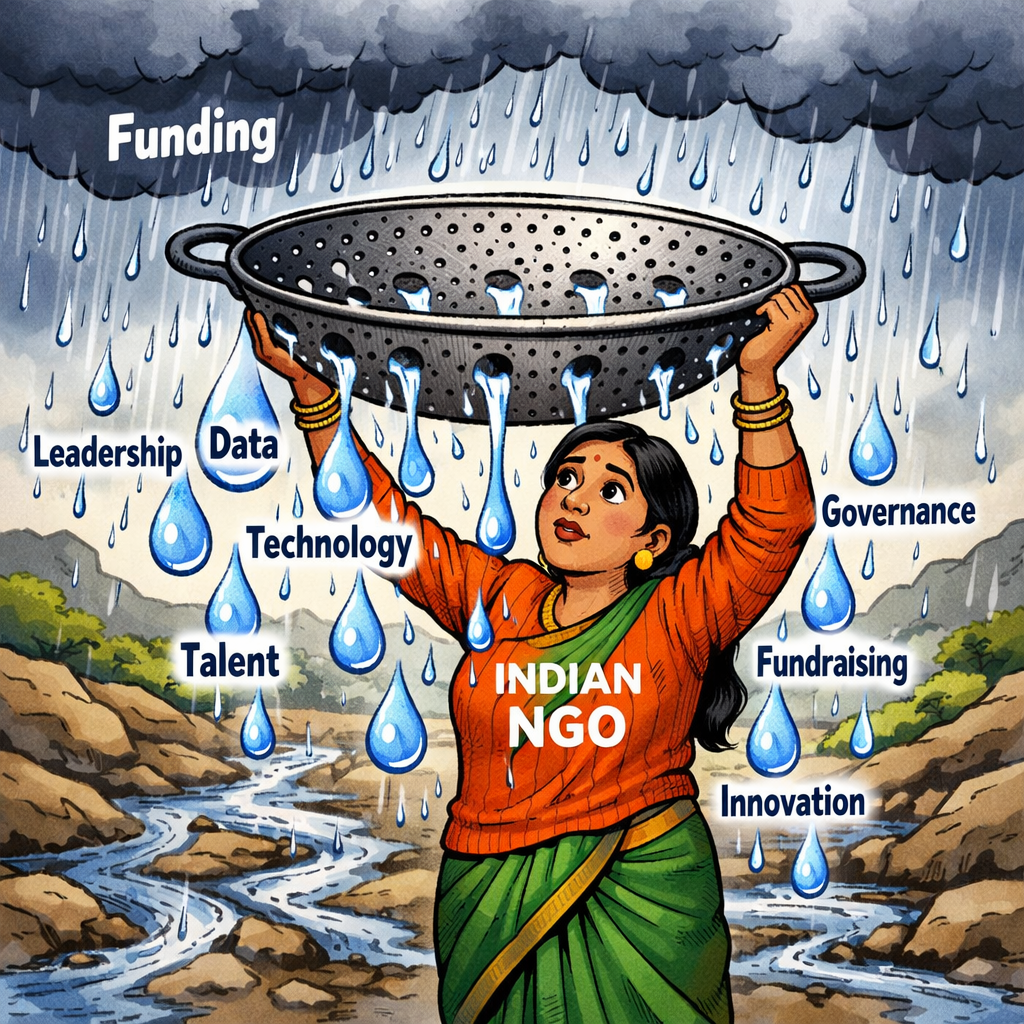
Yet most nonprofits are not resourced to operate this way. In fact early studies by Pay What it Takes, a Bridgespan initiative showed that:
We say we want systems change, but we fund projects.
We say we want scale, but we fund annual cycles.
We say we want sustainability, but we do not fund leadership, technology, data, or governance.
The consequence, documented extensively by Dasra and Bridgespan, is visible across the sector: founder-dependent organisations, thin middle management, weak data systems, and limited ability to take risks and engage government as a peer. As a result of this, impact doesn’t reduce marginally, it plateaus. And growth gets stifled. Organisations remain implementers instead of system partners.
Where this constraint is removed, the results are disproportionate.
We see this up-close from our work on rejuvenating water bodies that has spread across more than 15,000 villages. The breakthrough was not better water storage alone. It was the institutional stack behind it:
GIS-based prioritisation
Digital monitoring
A cost architectures that enabled convergence of public and philanthropic funding
Multilingual knowledge platforms
A network of civil society partners that ensured community ownership.
Government funded the physical work. Philanthropy funded the capability that made it effective. That is what allowed rapid adoption across states.
Our journey with QUEST reflects the same principle. Instead of chasing geographic expansion in early years, the organisation instead deeply invested in institutional foundations: diagnostic tools for student learning, leadership depth, HR systems, and a culture of data-driven practice. Over time, its influence has travelled beyond its direct footprint and today Quest serves more than a lakh children through its program annually. Quest is also replicating the model in the states of UP, Gujarat, and Madhya Pradesh in collaboration with other NGOs. And, has helped the State Council of Educational Research and Training (SCERT), Maharashtra, build two structured courses for Anganwadi workers.
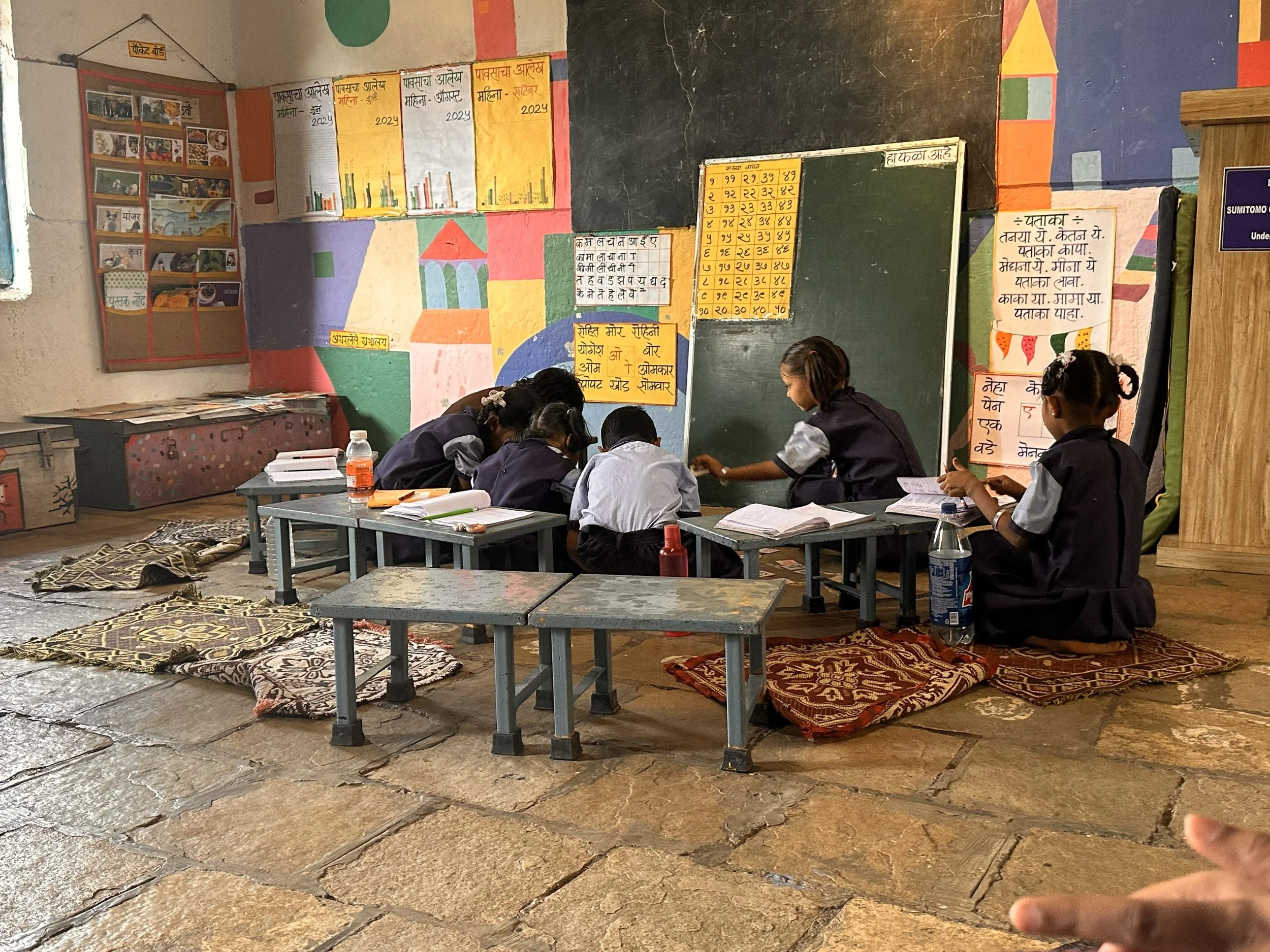
QUEST classroom in session
Simply put - Scale followed institutional depth and this resulted in a multiplier effect.
Across India’s Non-Profit landscape, exemplar organisations, whether policy-led, programme-led, others build digital public goods but the internal shifts are strikingly similar. They invest early in research and data to build credibility. They build leadership teams that can guide the organisations to shifting denominators and delivering expertise. They create coalitions instead of guarding attribution. Securing patient, flexible capital aligned to a long-term theory of change is fundamental to this shift. And this is where philanthropic return on investment is the highest: not in funding more activity, but in funding the capacity that makes all future activity more effective.
For CSR leaders accountable to boards, and for philanthropic foundations, this is not a philosophical question. It is a capital allocation one. Funding institutional capability does not increase overhead; it materially increases return on every future rupee spent in the system. Take for e.g. two other partners of ours – Antarang and OGQ. In their early years, small grants at Antarang and OGQ delivered important but limited reach. This helped them build proof of concept and test their ideas. However, their operations began to shift dramatically once they invested in leadership, systems, research and fundraising depth. The same capital began to travel exponentially, from hundreds to lakhs of youth, from a few athletes to an entire national pipeline. Capacity building or institution building became the storage that converted one season of funding into many seasons of impact.
If our goal is Viksit Bharat, the constraint will not be funding or the absence of solutions. It will be the lack of imagination in building a high-capacity institutional framework- capable of translating solutions into population-level change.
To help fund this, we must look at 7 key levers in every organisation we fund:
Strategy
Leadership depth & governance
Sustainable fund raising & communications
Monitoring, evaluation and learning (MEL) systems
Talent & culture
Technology infrastructure
Innovation
These are not overheads. These are pillars which comprise the impact infrastructure for the social sector to enable a Viksit Bharat.
Strategy prevents fragmentation, cuts out what is not working and helps sharpen focus
Leadership enables durability in thinking and strong partnerships – with the government, community and other actors
Data creates credibility and unlocks larger pools of capital.
Fund Raising – through a team frees up leader time to think about strategy and focus on impact strengthening rather than institution survival
Technology converts a model into a platform and unlocks operations at scale without losing fidelity.
Focus on HR processes allows institutions to outlast founders.
Innovation allows organisations to go beyond incrementalism and leap frog.
Rainfall is not the constraint.
Storage is.
In the social sector, capacity is that storage. Funding it deliberately may well be the most catalytic choice for CSRs and Indian philanthropy